
Commercial & Office Moving Services in Dubai
Professional Commercial & Office Moving Services in Dubai. Oxford Star Movers ensures minimal downtime with efficient packing, transport, and setup.
Moving an office in Dubai involves more than loading desks and boxes into a truck.
A successful commercial relocation requires careful planning around furniture, office equipment, documents, access arrangements, building management, loading areas, service elevators and the date your business needs to be operational again.
Oxford Star Movers provides commercial and office moving services in Dubai for businesses relocating to a new premises, moving between floors, expanding into a larger workplace or completing a phased office relocation.
Our approach focuses on understanding the practical requirements of your move before moving day. This includes identifying what needs to be packed, dismantled, protected, transported, reassembled and positioned at the new location.
Whether you are moving a small office or coordinating a larger commercial relocation, the right plan can help reduce unnecessary disruption and keep the move organised from the first item packed to the final workstation set up.
Need to plan your office relocation? Request a commercial moving quote from Oxford Star Movers.
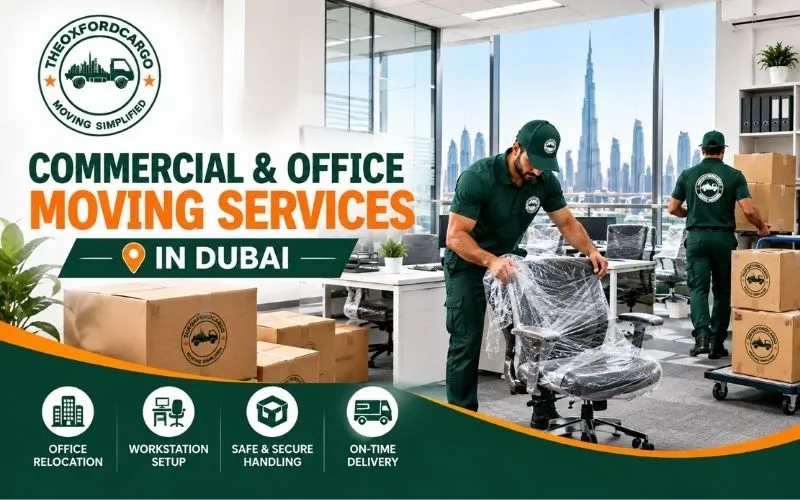
What Can Oxford Star Movers Handle During an Office Move?
Every business has a different workplace layout and different moving requirements. An office relocation may involve desks and chairs, workstations, filing cabinets, meeting-room furniture, computers, monitors, printers, documents and other business equipment.
The scope of the move can be planned according to the size of your office, the number of items involved and the conditions at both properties.
Office Furniture and Workstations
Office furniture often requires more preparation than simply carrying it from one room to another.
Desks, workstations, conference tables, cabinets, shelving units and reception furniture may need to be dismantled before they can be safely moved. Larger items should also be assessed against available access routes, doorways and elevator dimensions.
Where furniture needs to be dismantled, components can be organised so that reassembly at the destination is more straightforward.
If your relocation also requires furniture assembly after delivery, Oxford Star Movers offers dedicated furniture assembly services in Dubai.
Computers, Electronics and Office Equipment
Commercial offices often contain equipment that requires careful physical handling, including computers, monitors, printers, photocopiers, screens and other electronic equipment.
The moving plan should identify sensitive or valuable equipment before loading begins. Protective packing and organised labelling can help reduce the chance of equipment being misplaced during a multi-room or multi-floor relocation.
Your internal IT team or technology provider should separately manage system shutdowns, backups, network configuration and post-move connectivity testing.
Documents and Business Records
Office documents can quickly become difficult to manage when dozens or hundreds of cartons are moved without a clear labelling system.
Documents should be grouped according to departments, rooms or another system that makes sense for your business. Clearly identifying cartons before loading can make it easier to place them correctly at the destination.
Confidential records should also be separated and handled according to your company’s internal procedures.
Packing and Protection
Some businesses require complete packing, while others prefer to pack documents and smaller personal items internally and use movers for furniture and larger equipment.
Oxford Star Movers can coordinate the moving scope around the level of packing support required.
For businesses that need dedicated preparation, see our packing services in Dubai.
If the project also requires unpacking at the destination, our packing and unpacking services in Dubai can be considered as part of the relocation plan.
The Office Move Starts With the Building, Not the Boxes
One of the most overlooked parts of commercial relocation is access.
A moving team can have the right equipment and manpower, but the practical execution can still be affected if the building’s service elevator is unavailable, the loading area is restricted or security access has not been arranged.
Before moving day, businesses should check the requirements of both the current and destination buildings.
Service Elevators and Access Routes
Commercial towers and office buildings may have specific requirements for using service elevators.
Depending on the property, it may be necessary to confirm:
- Service elevator availability
- Elevator booking requirements
- Permitted moving hours
- Door and lift dimensions
- Weight limitations
- Security access
- Loading and unloading procedures
Large desks, conference tables, cabinets and other furniture should also be considered in relation to elevator and doorway dimensions.
If a large item cannot pass through the planned route, the moving team needs to know before moving day rather than after the furniture has already been transported to the building.
Loading Bays and Parking
The distance between the moving vehicle and the building entrance can affect how efficiently items are transferred.
Some commercial properties have dedicated loading bays, while others may have limited parking or controlled vehicle access.
Before the move, confirm where the moving vehicle can stop, how long loading or unloading is permitted and whether the building requires advance registration.
Building Management and Approvals
Requirements can vary between buildings, communities and commercial districts in Dubai.
Some properties may require access requests, management approval, security registration, insurance documentation, NOCs or specific moving schedules.
These requirements should always be confirmed with the relevant building or community management before the move.
This is particularly important for businesses operating from high-rise towers, free-zone properties or managed commercial developments.
Choose a Moving Schedule That Protects Your Business Hours
An office move does not necessarily have to happen during the middle of a normal working day.
For businesses that need to remain operational, the relocation can be planned around the company’s schedule where building access and the moving team’s availability allow it.
After-Hours and Weekend Office Moves
An evening or weekend move may be useful for companies that cannot easily close their workplace during normal business hours.
This can be particularly relevant for customer-facing businesses, offices with active teams or companies working to a specific relocation deadline.
The important point is to confirm the permitted moving hours with the building before finalising the schedule.
Phased Office Relocation
Not every business needs to move everything at once.
A phased relocation may be more appropriate when:
- Different departments have different operational requirements
- The destination is being prepared in stages
- The company needs to remain operational
- The office occupies multiple floors
- Temporary storage is required
- Furniture and equipment need to be transferred according to a sequence
A phased plan can divide the relocation into manageable stages rather than treating the entire office as one shipment.
For projects requiring temporary storage, Oxford Star Movers also provides storage services in Dubai.
For a combined requirement, businesses can also explore storage, packing and moving services in Dubai.
Internal Office Moves
Commercial moving does not always mean changing buildings.
Businesses may need to move furniture and equipment:
- Between floors
- Between departments
- Into a newly renovated area
- During office expansion
- During workspace reorganisation
An internal move still benefits from planning, especially when the workplace needs to remain operational during the process.
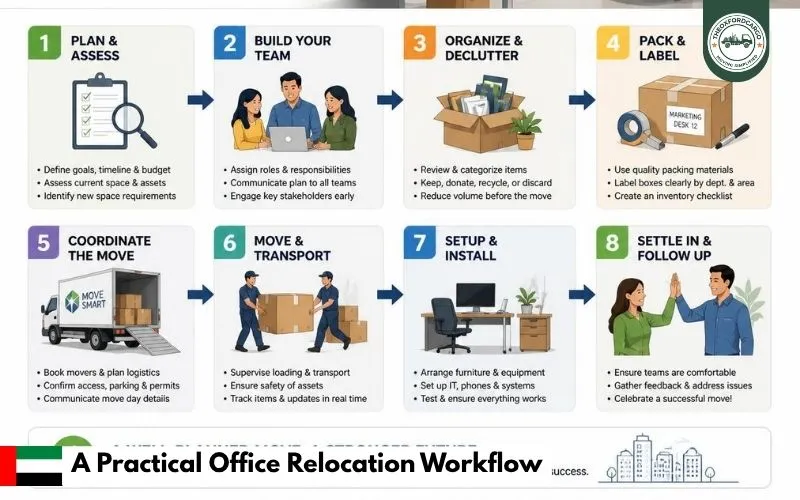
A Practical Office Relocation Workflow
A well-organised commercial move should be treated as a sequence of decisions rather than a single moving day.
1. Define the Scope
Start by identifying what is moving.
Create an inventory of major furniture, workstations, electronics, documents, storage units and other business assets.
The more accurately the scope is understood, the easier it becomes to plan labour, vehicles, packing and access requirements.
2. Review the Buildings
Check both locations for practical access.
Confirm the available entrances, service elevators, loading areas, parking arrangements and building requirements.
Also identify any unusually large furniture or equipment that may require additional planning.
3. Decide What Needs Packing
Determine whether your business needs full packing, partial packing or furniture-only moving.
Documents and smaller items can be grouped by department, room or workstation.
4. Label Items by Destination
A simple labelling system can make a substantial difference during unloading.
For example, cartons can be identified by:
- Department
- Floor
- Room
- Workstation
- Destination area
The objective is to make it clear where an item belongs before it arrives at the new office.
5. Dismantle and Protect Furniture
Furniture that cannot safely pass through the available route may need to be dismantled.
Items should be protected appropriately before transportation, particularly where surfaces could be scratched or damaged.
6. Load According to the Plan
The loading stage should follow the agreed scope rather than becoming an improvised process.
Critical items, fragile equipment and department-specific materials should be identified before loading begins.
7. Position and Reassemble at the New Office
At the destination, furniture and equipment can be placed according to the agreed layout.
Where applicable, dismantled furniture can then be reassembled.
8. Complete a Final Walkthrough
Before considering the move complete, the business should check the old premises and the new office.
Confirm that important furniture, cartons, equipment and documents have reached their intended destinations.
Moving IT Equipment Without Turning the Relocation Into an IT Problem
IT is one of the areas where office relocations can become complicated.
A moving company may physically transport computers, monitors, printers and other equipment, but the business’s IT team should normally remain involved in technology-specific tasks.
What the Moving Team Can Physically Handle
Depending on the agreed scope, physical moving requirements can include:
- Computers
- Monitors
- Printers
- Peripherals
- Screens
- Office electronics
- Equipment cartons
- Cables and accessories
These items should be organised and labelled so they can be matched to the correct workstation or department.
What the IT Team Should Plan
Your internal IT team or technology provider should determine how to manage:
- Data backups
- System shutdown
- Server shutdown
- Network configuration
- Internet services
- Telecom systems
- Software configuration
- Post-move connectivity
- System testing
This distinction is important because moving physical IT equipment and configuring an IT environment are two different tasks.
A good office relocation plan should coordinate both sides.
How Much Do Commercial and Office Moving Services Cost in Dubai?
There is no single price that applies to every office move.
The cost depends on the actual scope and conditions of the relocation.
Important factors can include:
| Cost factor | Why it matters |
|---|---|
| Office size | Determines the approximate volume of items |
| Number of workstations | Influences handling and dismantling requirements |
| Furniture quantity | Affects labour and transportation |
| Packing requirements | Changes materials and preparation time |
| IT equipment | May require additional protection and organisation |
| Building access | Can affect loading and carrying arrangements |
| Moving distance | Influences transportation requirements |
| Schedule | Timing can affect planning and availability |
| Storage | Adds storage and handling requirements |
| Phased relocation | May require multiple moving stages |
For this reason, businesses should provide as much information as possible when requesting a quote.
Useful information includes the current location, destination, approximate office size, workstation count, major furniture, packing requirements, preferred date and any storage needs.
For broader moving requirements, you can also explore Oxford Star Movers’ moving services in Dubai.
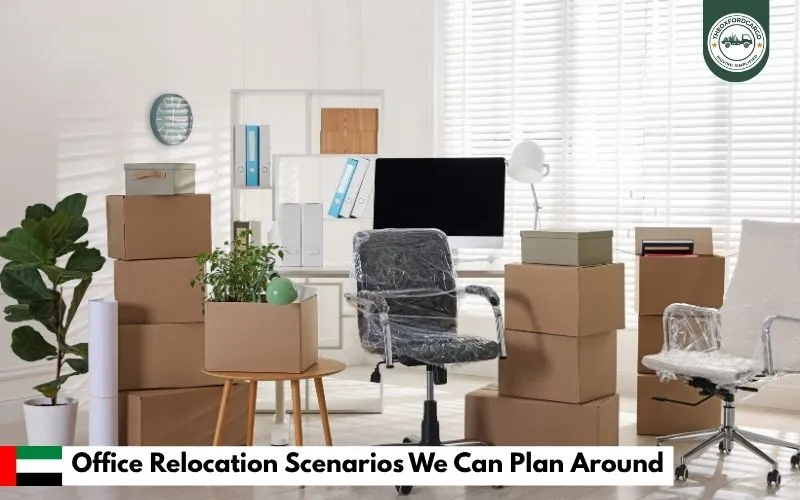
What Your Business Should Prepare Before Moving Day
A few practical preparations can make the relocation easier for everyone involved.
Before the Move
- Confirm the relocation date
- Assign an internal person responsible for coordination
- Confirm destination access
- Check building requirements
- Prepare an office inventory
- Identify sensitive equipment
- Confirm the IT plan
- Decide what requires packing
- Identify items that require dismantling
- Confirm storage requirements if applicable
During the Final Preparation
Label cartons according to their destination.
Separate documents or equipment that the business needs immediately after arriving at the new office.
Make sure building access and loading arrangements have been confirmed rather than assuming that access will be available automatically.
On Moving Day
Keep the moving route as clear as possible.
Make sure the relevant building contacts are available if access issues arise.
Have an internal contact available for questions about workstation placement, department locations or special items.
At the destination, use the agreed floor plan or labelling system to direct furniture and cartons to the correct areas.
Common Office Moving Problems — and How to Prevent Them
The Service Elevator Is Not Available
Problem: The moving team arrives but cannot use the required elevator.
Solution: Confirm elevator availability and booking requirements with building management before the moving date.
Furniture Does Not Fit the Planned Route
Problem: A large desk, cabinet or conference table cannot pass through the lift or doorway.
Solution: Identify oversized furniture during the planning stage and assess the available access route before transportation.
Boxes Arrive Without Clear Destinations
Problem: Staff have to open multiple cartons to determine where items belong.
Solution: Label cartons by department, floor, room or workstation before loading.
The Office Is Physically Set Up but IT Is Not Ready
Problem: Furniture has been placed but computers or network systems cannot immediately operate.
Solution: Coordinate the physical relocation with the company’s IT shutdown, reconnection and testing schedule.
The New Office Is Not Ready
Problem: Furniture arrives before the destination is ready for use.
Solution: Consider phased delivery or temporary storage where appropriate.
The Business Cannot Close During Working Hours
Problem: A daytime move could disrupt customers or employees.
Solution: Consider an evening, weekend or phased relocation, subject to building permissions and scheduling.
Office Relocation Scenarios We Can Plan Around
Commercial relocation requirements differ from one business to another.
Oxford Star Movers can structure moving requirements around different situations, including:
Small Office Relocation
A small office may have fewer workstations but can still require careful packing, furniture handling and access planning.
Corporate Office Relocation
Larger offices may require more detailed inventory, department coordination, workstation labelling and staged movement.
Multi-Floor Office Move
Moving between several floors introduces additional considerations around elevators, sequencing and destination placement.
Office Expansion or Consolidation
A company may need to move selected furniture and equipment rather than relocating its entire operation.
Same-Building Office Move
An internal relocation can require careful scheduling so that employees can continue working around the moving activity.
Phased Relocation With Storage
Businesses that cannot move everything immediately may require temporary storage between relocation stages.
Office Moving Across Dubai Business Districts
Dubai’s commercial environment includes a wide range of office buildings and business communities.
Commercial relocations may involve areas such as Business Bay, DIFC, Downtown Dubai, JLT, Dubai Internet City, Dubai Media City, Dubai Silicon Oasis, Al Quoz, Deira and Bur Dubai.
However, the requirements of an office move depend on the specific property rather than simply its neighbourhood.
A high-rise office in one part of Dubai may have very different loading and elevator procedures from another building nearby.
For that reason, businesses should confirm access, parking, loading and management requirements for the exact building involved.
Why Businesses Need a Commercial Moving Plan
An office relocation involves valuable physical assets and, more importantly, an operating business.
A commercial moving plan helps bring the different parts of the project together:
- What is moving?
- What needs packing?
- What needs dismantling?
- What requires special protection?
- How will the building be accessed?
- When can loading take place?
- Where should each department’s items go?
- Who coordinates the IT side?
- What needs to be ready before employees return?
The purpose is not simply to transport everything from one address to another.
It is to make the relocation organised enough that the business can move into the new workplace with a clear understanding of where its furniture, equipment and materials belong.
For businesses looking for broader movers and packers in Dubai, Oxford Star Movers can also support other moving requirements.
Frequently Asked Questions | Commercial & Office Moving Services in Dubai
How long does an office move take?
The time required depends on the size and complexity of the relocation, the amount of furniture and equipment, packing requirements, access conditions, distance and whether the move is completed in one stage or multiple stages.
Can an office move be completed in phases?
Yes, a phased relocation can be appropriate for businesses that need to remain operational, occupy multiple floors or require additional time to prepare the destination.
How much does office relocation cost in Dubai?
The cost depends on factors such as office size, number of workstations, furniture volume, packing requirements, access conditions, moving distance, scheduling and storage. A project-specific quotation is more useful than a generic price.
Can an office be moved after working hours?
An evening or weekend move may be possible depending on the moving schedule and the rules of the buildings involved. Businesses should confirm permitted moving hours with building management.
Can computers and office equipment be moved?
Physical office equipment such as computers, monitors and printers can be included in the moving plan. Your IT team should separately manage system shutdowns, backups, networking and post-move configuration.
Do office movers dismantle and reassemble furniture?
Furniture dismantling and reassembly can be included when required and agreed as part of the moving scope. Large or complex furniture should be identified during the planning stage.
Do I need building approval before moving an office?
Building requirements vary. Some commercial properties may require advance access arrangements, lift bookings, security registration, documentation or other approvals. Confirm the exact requirements with the relevant building or community management.
Can you provide storage during an office relocation?
Storage can be useful when the new premises is not ready, when a move is being completed in stages or when a business needs temporary space for furniture and equipment.
What do commercial and office moving services in Dubai include?
Commercial office moving can include packing, furniture dismantling, protection, loading, transportation, unloading, furniture placement and reassembly depending on the agreed scope. The exact service should be confirmed before the move.
What information should I provide when requesting an office moving quote?
Provide the current and destination locations, approximate office size, workstation quantity, major furniture, packing requirements, preferred moving date, access information and any special equipment or storage requirements.
Plan Your Commercial Office Move With Oxford Star Movers
A successful office relocation starts before the first desk is moved.
By identifying the items being relocated, checking building access, planning packing and labelling, coordinating IT requirements and deciding how the move will be staged, businesses can approach moving day with a clearer plan.
Oxford Star Movers provides commercial and office moving services in Dubai designed around the practical requirements of business relocation.
Whether you are moving a small workplace, relocating a larger corporate office, transferring between floors or planning a phased commercial move, the first step is to understand the scope of the project.
If you also need residential relocation support, explore our home moving services in Dubai, apartment moving services in Dubai or villa moving services in Dubai.